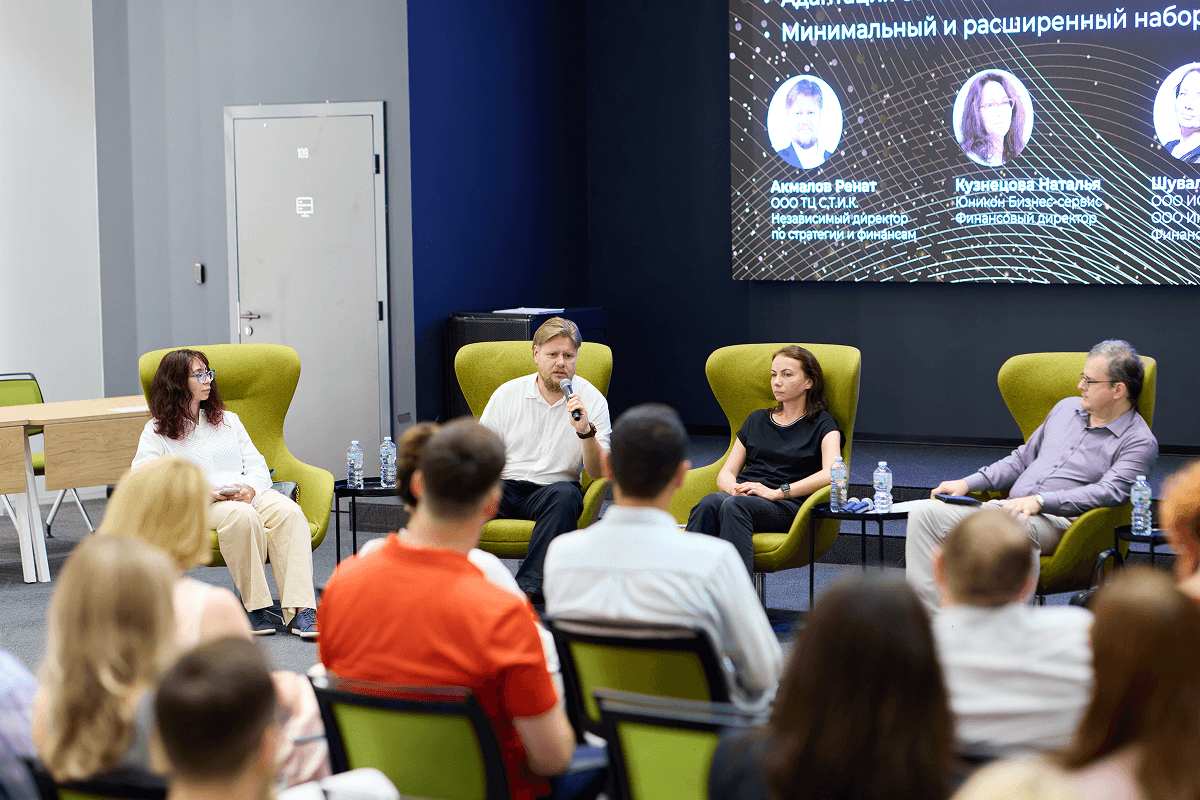


Action plan 2027: how CFOs can ensure business resilience - forum of the National Association of Financial Directors

About the conference
The Forum of the National Association of Financial Directors is a professional platform for CFOs, CEOs, business owners, and heads of finance and economics departments. More than 100 participants will gather in Moscow to discuss business financial strategy in the new economic environment, working capital management, tax changes, raising finance, and the use of new technologies in finance departments.
The program focuses on issues that finance executives are already dealing with today and that will become particularly important as companies prepare for 2027. Experts will present macroeconomic forecasts, discuss the prospects of the digital ruble and digital financial assets, share practical experience in loan restructuring, and demonstrate which finance processes can be automated using AI and RPA.
The forum places particular emphasis on the practical experience of CFOs and experts: real-life cases, solutions, and tools that can be applied in the work of finance and economics departments.
Why CFOs need to prepare for 2027
Finance departments have to deal simultaneously with the high cost of borrowing, changes in the tax environment, pressure on working capital, and the need to improve business efficiency without significantly increasing expenses.
At the same time, new tools and technologies are emerging. The digital ruble and digital financial assets are developing, AI and software robots are gradually becoming part of finance processes, and CFOs are increasingly expected not only to monitor financial performance but also to participate in the technological transformation of their companies.
At the NAFD Forum, participants will be able to assess these changes from the perspective of practical business needs and determine which solutions should be taken into account when developing their financial strategy and budget for 2027.

What will be discussed at the NAFD Forum
The program brings together five key areas of a modern CFO’s work: macroeconomics, taxation, financial resilience, new technologies, and improving the efficiency of finance and economics departments.
- Macroeconomic outlook and financial planning for 2027
Leading analysts will present their forecasts for the Russian economy and discuss the key risk factors for businesses. Participants will learn which indicators to focus on when preparing their 2027 budgets and how to develop financial assumptions when expert forecasts differ significantly.
The digital ruble will be another important topic. Using practical examples, experts will examine its use by businesses and the changes required in treasury operations, accounting systems, and interaction with banks.
- Tax changes and transfer pricing
Experts will discuss tax changes that may affect companies in 2027 and explain which new developments finance departments should prepare for in advance.
A separate session will focus on transfer pricing: criteria for determining related parties, pricing principles, tax risks, and ways to reduce the likelihood of claims from regulatory authorities.
- Working capital, financing, and working with banks
With borrowing costs remaining high and payment discipline weakening, working capital management is becoming one of the key priorities for CFOs. Using real-life cases, participants will explore how to reconsider approaches to accounts receivable and payable, inventories, and cash management.
CFOs will also share strategies for raising finance in a high-cost environment: how to negotiate with banks, which arguments to use, and where to look for additional sources of funding for business development.
Another practical topic is loan restructuring. Participants will discuss how to prepare for negotiations with a bank, agree on revised debt servicing terms, and preserve the company’s credit history.
- AI, RPA, and digital technologies in finance
Modern CFOs are increasingly becoming a link between business strategy, finance, employees, and IT. For this reason, a separate forum session will focus on developing CFOs’ digital competencies and the technological transformation of finance and economics departments.
Experts will examine the use of artificial intelligence and robotic process automation (RPA) in finance: which processes are suitable for a first pilot project, how to select tasks for automation, calculate the economic impact, and forecast costs.
According to the organizers, implementing AI and RPA in suitable processes can help reduce manual data entry errors and cut back-office operating costs by 20–40%. The forum will discuss how to achieve measurable results from new technologies without unnecessarily increasing the IT budget.
- How to improve the efficiency of finance and economics departments
Another area of the program focuses on internal finance processes. Participants will explore how lean management tools can be used to identify hidden inefficiencies, including lengthy approval procedures, duplicate reporting, manual reconciliations, and other operations that consume the team’s resources.
According to the organizers, this approach can free up as much as 30% of the team’s capacity without requiring multimillion-ruble investments in software.

Negotiation as a key CFO competency
A CFO’s work is not limited to numbers and financial models. CFOs regularly negotiate with business owners, banks, suppliers, tax authorities, and heads of other departments, often under pressure and in situations involving conflicting interests.
During the interactive workshop “Management duels: how CFOs can get the most out of any negotiation”, participants will practice techniques for dealing with pressure, ultimatums, and manipulation and learn how to turn difficult conversations from conflict into a search for solutions.
Experts with hands-on experience
The NAFD Forum will feature CFOs from major companies, economic analysts, banking representatives, and experts in taxation, corporate finance, and digital technologies.
Speakers will share practical experience in working capital management, raising and restructuring finance, tax planning, the use of digital financial instruments, and the implementation of new technologies in finance and economics departments.
Invited speakers include:
- Igor Selivanov — Deputy CEO of RBC, COO of Runity Group (REG.RU, RU-CENTER, SpaceWeb), lecturer at HSE University;
- Mikhail Podlazov — CFO of ALIDI Group;
- Ildar Gabbasov — CFO of Taber Trade (Podruzhka retail chain).
The Forum of the National Association of Financial Directors in numbers
- 100+ in-person participants — CFOs, CEOs, and business owners;
- 80+ online participants;
- 15 practitioners — CFOs and experts;
- 10+ relevant topics — from taxation and financial resilience to AI and executive efficiency.
Who should attend
The forum is designed for executives and professionals responsible for their company’s financial resilience, efficiency, and development:
- Chief Financial Officers (CFOs);
- heads of finance and economics departments;
- business owners;
- CEOs;
- chief accountants.
In-person and online participation
Participants can join the NAFD Forum either in person or online. In-person attendees will have access to the full business program, speakers’ materials and presentations, the forum recording, and a private chat. They will also be able to network with colleagues and experts during networking sessions, coffee breaks, lunch, and a private reception.
Online participants will have access to the live broadcast, speakers’ presentations and materials, a private chat where they can ask questions, and a recording of the forum after the event.
Venue of Action plan 2027: how CFOs can ensure business resilience
Planning to attend Action plan 2027: how CFOs can ensure business resilience
Be the first to join!
Additional information

Action Finance is a corporate reference and educational platform for CFOs, economists, and finance professionals. It brings together professional reference systems, industry publications, training programs and services, and also organizes business events for finance executives and experts.
Photos